-2.png?width=100&height=100&name=V%20(1)-2.png)
Marketing Strategy vs Tactics: What Most Businesses Get Wrong
.jpeg?width=50&name=1723225351108%20(1).jpeg)
Most businesses aren’t failing at marketing. They’re failing at deciding.
They have not decided who they are actually for.
They have not decided what they want to be known for.
They have not decided where belief is created in their system.
They have not decided what they will ignore, even if it looks like an “opportunity.”
So they do the only thing that feels responsible under uncertainty: they stay busy with tactics.
They publish more. They launch campaigns. They tweak the website. They “test” ads. They add a nurture sequence. They change the offer. They try a new channel. They hire a freelancer. They switch agencies. They buy another tool.
It can look and even feel like real momentum.
Eventually someone says the line everyone says after enough cycles of this:
“Marketing doesn’t work.”
That’s not true. Marketing still works, and it works really well when you have tactics aligned with an overarching strategy that rarely changes.
If you are a business owner who wants compounding, predictable growth, you’re in the right place.
Marketing Strategy vs Marketing Tactics: The Real Difference
Let’s define this cleanly.
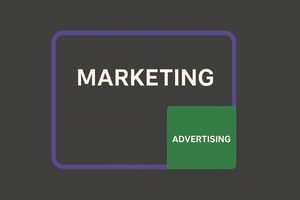
Marketing Strategy Is the Upstream Decision System
Marketing strategy is the upstream decision system that determines:
- Target market: who your business serves
- Market segmentation: which subsets inside that target market you prioritize, and which you deprioritize
- Brand positioning: the psychological frame of your brand relative to real competition
- Belief design: where trust is earned, how, and in what sequence
- Resource allocation: where time, money, attention, and talent go, and where they do not
Marketing Tactics Are the Downstream Expressions
Marketing tactics are the downstream expressions of those decisions:
Ads, content, email, landing pages, SEO, webinars, events, partnerships, outbound, funnels, creative, offers, and all the execution details everyone argues about far too much.
Strategy decides the rules of the game.
Tactics play inside those rules.
Strategy is your time for thinking and contemplation.
Tactics are time for executing, and far less debate.
When strategy is real and clear, tactics become obvious and easier to execute. When strategy is missing, tactics become political, exhausting, and fragile. Everyone has an opinion because there is no governing logic.
This is why marketing teams can be “high output” and still underperform. They are executing without a stable, focused map.
Why Businesses Confuse Marketing Strategy and Tactics
Most businesses skip strategy because it’s uncomfortable.
Tactics feel like action and control. Strategy feels like talk and overthinking.
Tactics give you activity, dashboards, deliverables, and the illusion of progress. Strategy forces trade-offs, exclusions, and the possibility that you have been spending time and money in the wrong places.
Under uncertainty, humans default to action because action reduces anxiety. This shows up as tactical churn, endless movement meant to create a sense of safety.
Business owners feel this in their bones. When revenue feels unstable, doing more marketing feels safer than sitting still long enough to think.
So the organization becomes a factory of tactical output that never earns compounding trust.
The irony is brutal: the thing you are doing to feel safe is the thing preventing stability. To be clear, tactics are very important, and you can get traction and even some momentum with just tactics, but you cannot get serious momentum with only tactics.
Marketing Strategy in the AI Era: Execution Is Cheap, Judgment Is Expensive
Ten years ago, even just decent marketing execution was scarce. Today, it’s cheap.
AI has collapsed the cost of producing “fine” marketing. Anyone can ship competent copy, competent creative, competent campaigns. The floor has risen.
So the differentiator is no longer “can you execute.” It is “can you decide.”
If your strategy is unclear, AI will not save you. It’s actually more likely that it will accelerate the chaos.
AI amplifies whatever you feed it. Focus turns into leverage. Distraction turns into random noise at scale.
This is why the edge is not volume, it’s alignment between the vision, ethos, strategy, and tactical layers of the brand.
Why Marketing Strategy Makes Marketing Tactics Easier
Here’s the standard failure mode:
- Business does not decide a market or segment clearly
- Business does not choose a position it can defend
- Business does not define how trust is earned
- Business still needs leads
- Business runs tactics (SEO, cold email, cold calling, etc.) harder
- Those tactics underperform because the system is incoherent
- The business concludes “marketing doesn’t work”
- It switches tactics again
This is not marketing. This is promotion at best, and lazy guessing at worst.
Real strategy prevents thrashing by doing one thing: it creates constraints and focus that remove ambiguity.
A real strategy reduces your tactical option set. It narrows the number of viable moves. It makes the next right action obvious, and therefore easier to execute consistently. Consistency is what compounds because you are just one choice of many in the marketplace, and the marketplace needs to see you numerous times before they’re ready to buy.
The 5 Pillars of Marketing Strategy: Target Market, Segmentation, Positioning, Trust, and Resource Allocation
1. Target Market Definition: Relevance Beats Reach
Most target market definitions are lazy, broad, and useless: “B2B.” “SMBs.” “Founders.” “Service businesses.”
That is not a target market. That is a category.
A real target market definition is a commitment. It forces specificity:
- Who is the actual person that can sign the check or make the purchase, not just the company?
- What situation are they in right now?
- What constraints are they operating under?
- What pain are they already paying for?
- What outcome actually matters to them?
- What do they refuse to tolerate (time waste, risk, uncertainty, vendor nonsense)?
- Where do they live?
- How much money do they make?
- What’s their favorite social media platform?
- Do they use search engines to make purchasing decisions?
- What gurus do they follow?
- What events do they attend?
This is where excellent marketing starts. Buyers do not respond to generic messaging because they have seen it all. They respond to accuracy.
If you cannot describe the buyer’s world with precision, you have no right to expect them to give you their most prized possession: their time.
And if you try anyway, you will eventually default to tactics you said you’d never stoop down to: urgency, hype, manufactured confidence, and generic claims.
Marketing should reflect value, not inflate it.
2. Market Segmentation Strategy: Prioritize or the Market Will Choose for You
Segmentation is where most “strategies” collapse because segmentation forces prioritization.
Most businesses refuse to prioritize because prioritization means letting go of potential revenue. It feels like leaving money on the table, but in practice it usually increases it because specificity and frequency matter a lot in marketing.
Here’s the truth: if you do not choose, the market will choose for you. And it will usually choose the worst-fit buyers because broad marketing attracts price shoppers, opportunists, and people looking for shortcuts.
Segmentation answers:
- Which subset has the highest willingness to change now?
- Which subset values your strengths the most?
- Which subset has the least friction to purchase?
- Which subset creates second-order benefits like referrals, reputation, retention, or learning?
- Which subset has a pain you can diagnose better than everyone else?
- Which subset is your value proposition strongest with?
Segmentation is also resource allocation logic. It tells you where to spend your attention.
3. Brand Positioning Strategy: The Psychological Frame the Buyer Uses to Compare You
Positioning is not a tagline. It is not a vibe. It is not “our mission.”
Positioning is the frame that determines what the buyer compares you against, and what dimension they use to evaluate the choice.
Positioning answers:
- How are we better than alternatives?
- What do we refuse to be?
- Why should they believe us?
Most businesses “differentiate” by listing features, claiming quality, and hoping the buyer connects the dots.
That is weak.
Strong positioning does the opposite: it makes the decision simpler, because it clarifies the real trade-off.
Examples of real positioning trade-offs:
- Speed vs rigor
- Cheap vs accountable
- Generic execution vs diagnostic clarity
- High output vs high truth density
- Hype vs trust compounding
If your positioning does not force a trade-off, you are not positioned.
And if you are not positioned, tactics will always feel like a trip to the casino.
4. Trust and Belief Design: Where Belief Is Earned in Your Marketing System
Every business has a belief pathway, whether it admits it or not. The buyer must believe something before they will act, and that belief must be earned somewhere.
Some businesses earn belief through depth, diagnosis, consistency, and proof. Others earn it through trial, visibility, social proof, narrative, and community.
If your business is fundamentally “depth earns trust,” but your marketing is built like a hype machine, you create a huge psychological gap. Sophisticated buyers, in particular, feel it instantly.
Belief design is the mechanism that makes marketing feel calm instead of desperate.
5. Resource Allocation in Marketing Strategy: Budget, Time, Talent, and Focus
This is where strategy stops being theory.
Strategy is where you decide what gets budget, headcount, repetition, and what gets ignored.
Most businesses allocate resources tactically. They chase whatever looks hot, whatever the competitor is doing, whatever the agency is selling, and whatever feels like it might create a spike as soon as possible.
That is not strategy. That is, frankly, impulsive mood-based spending.
If your best segment builds trust through depth, allocate to content that proves depth, offers that reduce uncertainty, sales processes that feel diagnostic, and channels where your best buyers actually pay attention.
If you do not do this, you end up spreading effort across too many channels with too many messages. Nothing lands. Nothing sticks. Nothing compounds.
You usually do not need more content. You need fewer messages repeated with more integrity.
When Marketing Strategy Is Right, Marketing Tactics Stop Being Debates
This is the payoff of doing your thinking upfront.
When target market, segmentation, positioning, belief design, and resource allocation are clear, tactical questions get easier.
You stop asking: “Should we be on this platform?”
You start asking: “Does this platform reinforce the belief we are trying to earn with this segment, at this stage of trust?”
You stop asking: “Should we run ads or do content?”
You start asking: “Which mechanism reduces uncertainty fastest without eroding trust?”
You stop asking: “Should we change the offer again?”
You start asking: “Is the offer aligned with the way trust is earned here, or are we trying to skip steps?”
That is the difference between a business with compounding marketing and a business with perpetual churn.
The Hidden Costs of Tactical Marketing Churn
1. Trust Never Compounds
Your messaging changes too often. Your promises mutate. The buyer cannot build a stable mental model of who you are, so you get ignored.
The market starts treating you like just another option, not a credible option.
2. Learning Never Accumulates
If you change tactics constantly, you cannot learn what is actually happening. You cannot isolate variables. You cannot build a durable playbook.
Your marketing becomes anecdotal. You manage it through vibes.
3. Value Gets Inflated Instead of Proven
When clarity is missing upstream, tactics try to compensate with persuasion. That leads to pressure, inflated claims, and “look at us” marketing that erodes trust long-term.
Marketing should reflect value, not inflate it.
Marketing Strategy Checklist: The Litmus Test for Strategy vs Activity
Here is the simplest diagnostic I know.
If all marketing execution stopped tomorrow, would you still have absolute clarity on:
- who you are for
- which segment matters most right now
- what position you are defending
- where trust is earned, in what sequence
- where resources should go when you restart
If the answer is no, your problem is not execution.
It never was.